
Does a safe bank balance guarantee a safe long-term standard of living?
I was talking to my wife about her savings this week and she asked me about whether it was worth investing into the markets when interest rates are looking good for savers. It is true, Czech banks are advertising attractive savings rates and some headline offers are around 4% or higher. This is good news for savers who need accessible cash or income today. But a safe bank balance does not necessarily mean a safe long-term standard of living.
Good income today — but for how long?
Some Czech savings accounts advertise rates around 4%, although the highest offers often depend on conditions, balance limits or promotional periods. At 4% gross, CZK 1 million earns CZK 40,000 annually, or CZK 34,000 after the usual 15% withholding tax. Eligible deposits generally benefit from protection up to the equivalent of €100,000 per depositor per bank.
However, savings rates are variable. If the same CZK 1 million later earns only 2%, annual after-tax interest falls to CZK 17,000. Meanwhile, inflation continues to increase the cost of living. At 2.5% inflation, a 4% savings rate leaves a real after-tax return of only about 0.9%.
The evidence: cash versus investment
Long-run research in the UBS Global Investment Returns Yearbook 2026 reports historical US inflation-adjusted annual returns of approximately 6.6% for equities, 1.6% for government bonds and 0.5% for Treasury bills over 1900–2025. These figures are not forecasts for Czech investors, but illustrate why cash can struggle to protect purchasing power over decades.
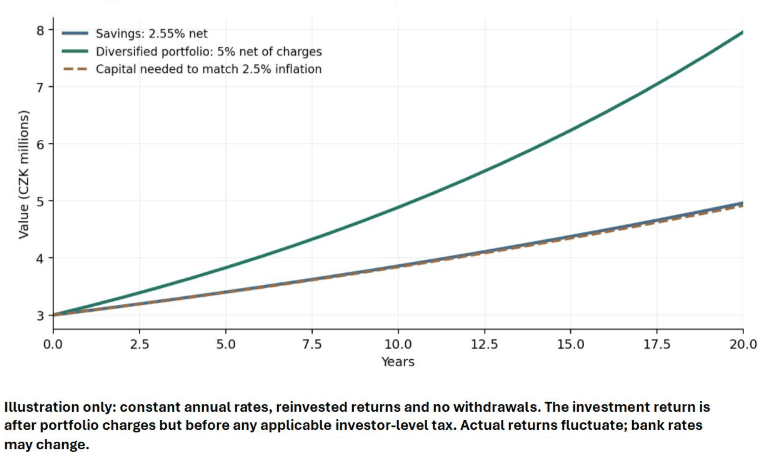
For illustration, CZK 3 million growing at 2.55% after tax becomes about CZK 4.97 million after 20 years. At 5% annual growth after charges, an investment portfolio would reach about CZK 7.96 million before any investor-level investment tax. With 2.5% annual inflation, CZK 4.92 million would be needed merely to preserve today’s purchasing power. These are constant-return scenarios, not predictions.
A combination of accessible bank savings and a diversified, risk-appropriate investment portfolio may be more resilient than either alone.
Illustrative growth of CZK 3 million over 20 years
When does investment risk break even?
There is no fixed year when investing becomes safer than cash. Cash generally carries less short-term capital risk, while diversified investments offer greater long-term growth potential alongside the possibility of losses. A portfolio can fall sharply just when withdrawals are needed, and even long holding periods do not eliminate market risk.
The practical break-even question is whether the investment’s expected return after costs and tax adequately compensates for its volatility and the investor’s withdrawal needs. If savings earn 4% gross (3.4% after withholding tax), an investment must exceed 3.4% after its own costs and taxes to produce more wealth under otherwise identical constant-return assumptions. That mathematical threshold does not mean the investment has become risk-free.
Which approach is safer? (question from my wife)
For emergency reserves and spending over the next one or two years, protected savings accounts are often appropriate. For money intended to fund retirement over ten or twenty years, relying entirely on cash can create inflation and income risk. A combination of accessible bank savings and a diversified, risk-appropriate investment portfolio may be more resilient than either alone.
The key is not to eliminate every fluctuation, but to ensure money is available when needed while protecting future purchasing power.
