
Small portfolio adjustments can bring useful tax savings—provided you understand what the exemption actually covers.
December brings Christmas shopping, crowded calendars and, for Czech investors, a useful question: could you rebalance part of your portfolio before the year ends without creating a tax bill?
The Czech CZK 100,000 securities exemption may help. But there is one detail that deserves more attention than the festive wrapping.
It applies to sale proceeds—not investment profits.
The rule in plain English
For an individual Czech tax resident holding investments outside business assets, securities sales can qualify for exemption if their combined gross proceeds do not exceed CZK 100,000 in the calendar year.
That means adding together securities sales across your investment accounts. It is not a separate limit for each broker, fund or ETF.
If the total exceeds CZK 100,000, you do not simply deduct that amount as an allowance. You must assess whether another exemption applies, such as the three-year holding-period test.
For example, selling investments for CZK 100,000 that originally cost CZK 80,000 realises a CZK 20,000 gain. If the annual proceeds exemption applies, that gain is exempt. At an assumed 15% tax rate, that represents CZK 3,000 of potential tax avoided.
What could it save on a CZK 3 million portfolio
Imagine investing CZK 3 million, with hypothetical growth of 5% a year, and selling CZK 100,000 of the original holdings at each of three annual rebalancing points.
For this example, all sales occur before the relevant holdings qualify for the more-than-three-year exemption, and there are no other securities sales in those calendar years.
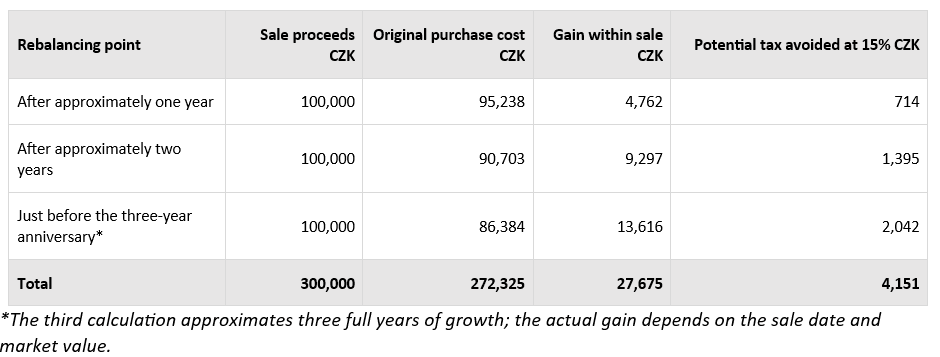
The illustrative benefit is approximately CZK 4,151 over three years, before dealing costs. That is about 0.14% of the initial CZK 3 million portfolio.
It is a useful saving, rather than a tax jackpot. A CZK 3 million portfolio does not turn this into a CZK 100,000 annual profit allowance.
These figures measure tax that would otherwise apply to those gains at 15%. They are not necessarily savings compared with simply holding the investments until they qualify for the three-year exemption.
Why rebalancing matters
Rebalancing means adjusting your investments to maintain your intended risk and asset mix—for example, trimming an equity holding that has become too large and adding to bonds.
If the necessary sales fit within your remaining annual proceeds limit, the exemption may allow that adjustment without tax on the realised gain.
The benefit depends on how much profit is embedded in the investments sold. CZK 100,000 of sales containing a CZK 30,000 gain could avoid CZK 4,500 of tax at 15%. The same sales containing only a CZK 5,000 gain could avoid CZK 750.
Before the calendar turns
Check your total securities sale proceeds for the year, including other accounts. If you have already sold CZK 70,000, only CZK 30,000 remains before reaching the threshold.
Allow time for execution and settlement, and confirm which calendar year the proceeds belong to. For foreign-currency investments, check the required CZK conversion. Leave some headroom for price and currency movements.
Also check purchase dates: holdings already eligible for the three-year exemption may need no additional planning. Replacement investments have their own acquisition dates.
Unused capacity does not roll forward. But that is no reason to make an unnecessary trade: costs, investment suitability and the existing holding-period exemption may outweigh the benefit.
This article provides general information, not personal investment or tax advice. The example assumes 15% tax, no losses or other reliefs, and unchanged rules over the illustration period. Some gains may fall within the 23% tax band, depending on total taxable income. Obtain Czech tax advice before acting.
