

How a 5% charge can erode a €100,000 investment over five years
As a follow-up to the last insight, that looked at the cost of commission based savings plans, it is also worth looking at the same effects for lump sum investors. Investors often focus on investment performance when choosing a financial product. But there is another important consideration, how much of their money is actually invested, and how much disappears in charges and commissions?
Some traditional investment products, including insurance-based investment bonds and certain general investment account (GIA) arrangements, may involve an initial charge or bid-offer spread. If a similar charge applies when investments are switched, costs can accumulate. Consider a single €100,000 investment held for five years.
What is a 5% bid-offer spread?
Aisa International does not recommend such funds but it is worth understanding that a large proportion of Czech investment advisers do recommend them. A bid-offer spread is the difference between the price at which an investment is purchased and the price at which it can be sold. In some commission-funded arrangements, an initial allocation or distribution charge can have a similar economic effect. A 5% deduction from €100,000 leaves €95,000 invested. That amount must rise by 5.26% just to restore the original €100,000.
A genuine market spread is not necessarily adviser commission. Nor do all GIAs impose such charges, the actual product terms and disclosure documents must be checked.
A five-year comparison
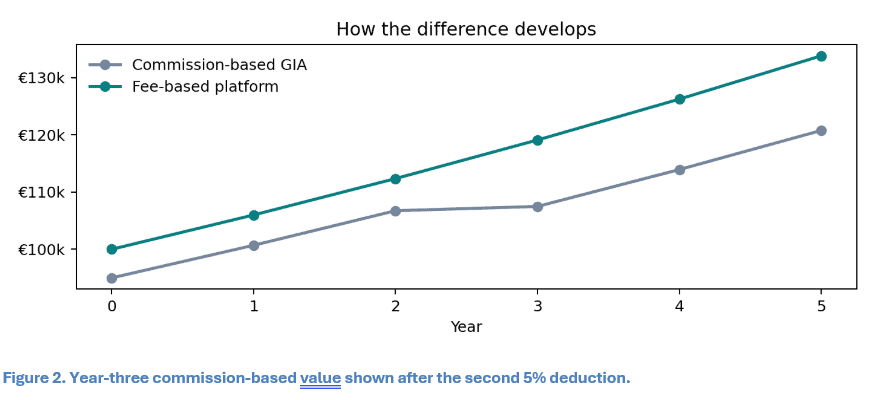
Assume both arrangements earn 6% gross investment growth each year. The commission-based arrangement deducts 5% initially and a further 5% from the entire portfolio when it is sold and reinvested at the end of year three. The fee-based platform has no percentage entry or switching charge in this illustration. Separately agreed advice fees, ongoing fund/platform costs, dealing costs and tax are excluded from both sides.
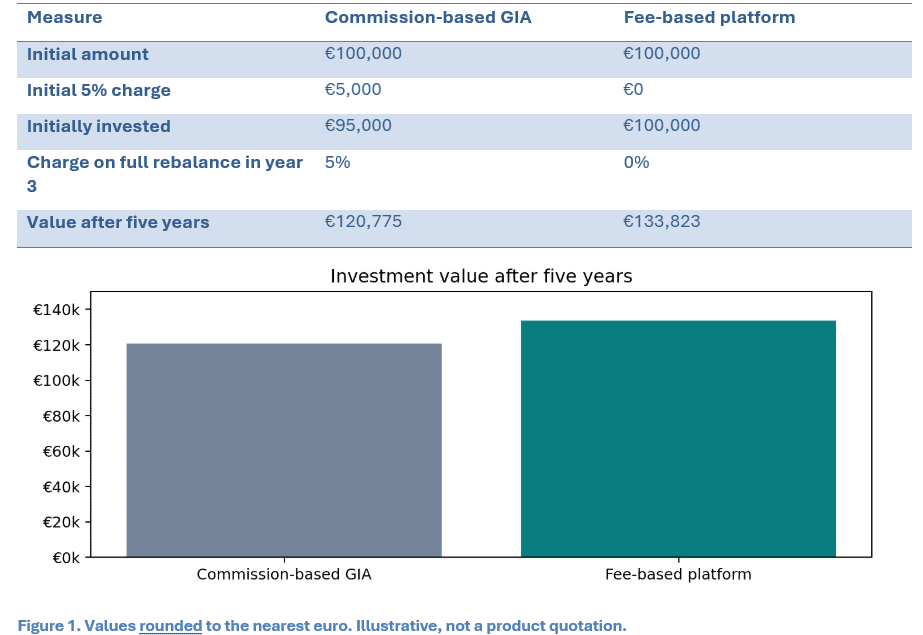
The fee-based arrangement ends approximately €13,048 ahead. This is not simply the sum of two 5% deductions: the investor also loses the investment growth that the deducted money might have earned.
For internationally mobile investors, transparent costs and the ability to adjust investments without disproportionate penalties can be especially valuable.
Why rebalancing costs matter
Rebalancing is a normal part of maintaining an appropriate investment risk profile. After a strong period for equities, for example, an adviser may sell some equity holdings and buy other assets. If the arrangement imposes a fresh 5% charge on switched money, the cost can be considerable.
The example assumes the whole portfolio is switched at the end of year three. In practice, only part may be rebalanced. If €30,000 is switched and the full 5% charge applies to that transaction, the immediate charge would be €1,500—not 5% of the entire portfolio.
Is fee-based advice free?
No. A transparent platform still involves fund costs, platform administration, potential dealing costs and any separately agreed adviser fee. A proper comparison should include all these costs. However, the investor can see what the adviser is being paid and assess whether the advice is worth the fee, without assuming a repeated percentage entry charge is unavoidable.
Could a commission-based product be justified?
Some insurance-based investments provide specific tax, succession or other benefits that may justify additional costs for particular investors. A conventional GIA does not automatically provide those benefits. The decision should consider the product’s legal structure, the investor’s tax residence, access restrictions, actual charges and suitability—not simply headline investment performance.
Conclusion: pay for value, not repeated charges
In this five-year illustration, €100,000 grows to approximately €133,823 before fees on a no-entry-charge platform, versus €120,775 when a 5% initial charge and a further 5% charge on full reinvestment are imposed. The difference is approximately €13,048 before separately agreed advice and ongoing costs.
For internationally mobile investors, transparent costs and the ability to adjust investments without disproportionate penalties can be especially valuable. Good financial advice should help manage risk and make informed decisions—not depend on opaque product charges.
Important information
This hypothetical example assumes a constant 6% annual gross return, with charges applied as stated. It is not a market-average charge comparison or an actual product quotation. Returns are not guaranteed; investments can fall in value. Figures exclude inflation, currency movements, tax, ongoing charges and separately paid advice fees. Not every rebalance triggers a charge, and charges may apply only to the portion switched. Individual suitability and the applicable product documentation must be reviewed.
