

How money is invested, and how the adviser is paid, can make a substantial difference to the eventual value.
For those living in Europe, saving €500 a month towards retirement or other long-term goals can be an excellent decision. But how the money is invested, and how the adviser is paid, can make a substantial difference to the eventual value.
Traditional insurance-based regular savings plans may pay the adviser an upfront commission, recovered indirectly through product charges. These are commonly sold by tied-agents of insurance companies or banks. An alternative is a regulated investment platform with a separately agreed initial advice fee and transparent ongoing investment costs. Usually offered by fee-based independent investment advisers like Aisa International.
How commission-based plans work
Insurance savings plans can combine investments with a policy and may impose establishment, administration, fund and policy charges. Some older contracts also have initial-unit charges or early surrender penalties. The investor should examine the full contractual costs and the consequences of stopping contributions. Not every insurance policy has these drawbacks; some provide useful tax or estate-planning features.
The fee-based platform alternative
With a fee-based arrangement, the client pays an agreed initial advice fee and invests through a platform holding suitable funds or ETFs. This can improve transparency and flexibility, although platform fees, fund charges and any subsequent advice costs still need to be considered.
The important lesson is to compare total costs, flexibility, tax treatment and investor protections rather than assuming commission-funded advice is free.
What could €500 a month become in 10 years?
Assume €500 invested at each month-end for 10 years (€60,000 total), with the same 6% gross annual return in both arrangements. Illustrative ongoing costs are 3% a year for the insurance plan and 0.75% a year for the platform. The platform also has a €1,000 initial advice fee, paid separately.
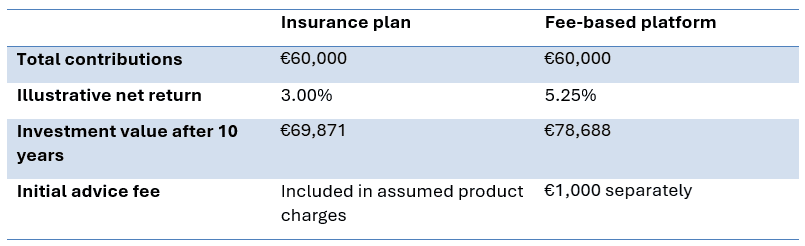
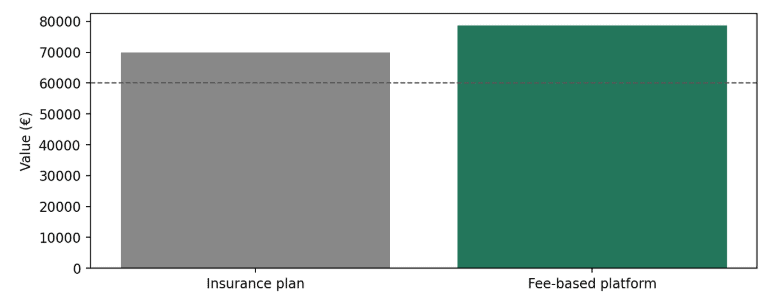
After deducting the separate €1,000 advice fee, the platform produces approximately €7,818 more wealth in this illustration. These charges are assumptions, not verified market averages or product quotations.
Why annual costs compound
Charges reduce not only the balance invested today but also the growth that the deducted money might have earned in future years. Over longer periods, seemingly modest differences in annual charges can become material.
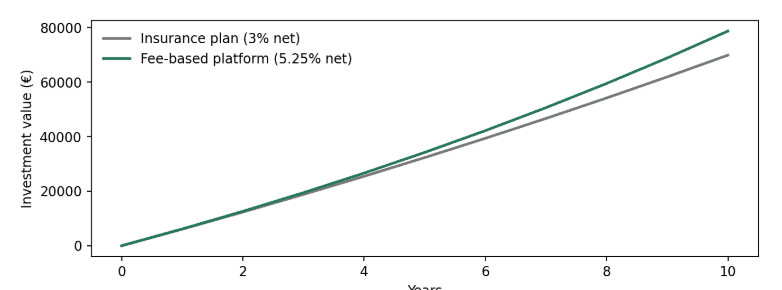
Illustrations assume constant returns and monthly compounding; the line chart excludes the separately paid €1,000 initial advice fee.
Flexibility matters to expatriates
People may move countries, change jobs or change tax residence. A conventional platform may allow them to vary or suspend contributions more easily than some long-term insurance contracts (often at a heavy price).
Pay for advice, not unnecessary product charges
Under the assumptions above, the fee-based platform is better value over 10 years. The important lesson is to compare total costs, flexibility, tax treatment and investor protections rather than assuming commission-funded advice is free. For many investors, professional advice combined with a transparent, competitively priced platform can be an attractive solution. Aisa International only works on a clear transparent basis and does not take commission from investment funds or platforms.
Important information: All figures are hypothetical, not forecasts. Returns are not guaranteed; investments can fall. Figures exclude taxes, inflation and currency effects. Product-specific terms and individual suitability must be assessed.
