
The Manila IFA, the Facebook Group, and the Czech Law They’ve Never Heard Of
Someone asked for pension advice in a British expats group. What followed was a masterclass in why you should always check credentials before taking investment advice abroad.
It started, as many things do these days, on Facebook. Someone posted in a British expats group here in the Czech Republic asking for investment and pension advice. A sensible thing to need. I replied that I could help and was completely ignored.
There were a couple of comments, however. First came the warning — from someone who had clearly been burned before — that no expat should ever trust a financial adviser, full stop. A fair ifslightly scorched-earth position that did not help the person requiring advice. Then, riding in on a white horse, came someone presenting themselves as an Independent Financial Adviser, ready to help.
A closer look at their profile told a different story
They appeared to be a representative of a firm regulated in the Philippines. Based in Manila. Offering investment services to British expats living in Prague.
At this point, one has to ask: does this person have any idea what Czech and EU financial law says about exactly this situation? The answer, almost certainly, is no.
So let’s fill in the gap for them — and for anyone else tempted to take advice from whoever shows up in a Facebook comment.
To legally provide or promote investment services in the Czech Republic, a firm needs authorisation from the Czech National Bank — the ČNB — or a regulatory passport from another EU or EEA member state. The Philippines is not in the EU. It is not in the EEA. A licence from the Securities and Exchange Commission in Manila carries precisely zero regulatory weight on the banks of the Vltava.
This isn’t a technicality. It’s a hard prohibition. The moment our Manila-based commenter starts soliciting Czech-resident clients — even via a Facebook comment, even with the best intentions — they are operating outside the law.
The consequences, should the ČNB take an interest, are not trivial.
The regulator can fine unauthorised firms up to CZK 150 million — roughly €6 million — or 10% of annual turnover, whichever is higher. They can issue public warnings, naming the firm, which get circulated across EU regulators and effectively blacklist the business across the entire bloc. They can issue cease-and-desist orders. And they can refer the matter to criminal prosecutors.
For the individual representative — the person typing cheerfully into a Facebook comments section — the personal exposure is real. Under the Czech Criminal Code, providing investment services without authorisation can mean up to two years in prison. If it can be shown that the activity caused financial harm, or was part of a broader scheme, that rises to five years. Not the outcome one imagines when offering to help someone with their pension.
Did you know that the promotion of investment advice is, in itself, a regulated activity. The individual should be on the Czech National Bank register.
A Facebook comment is still a solicitation.
“I can help” is still a promotion. The medium doesn’t change the legal reality.
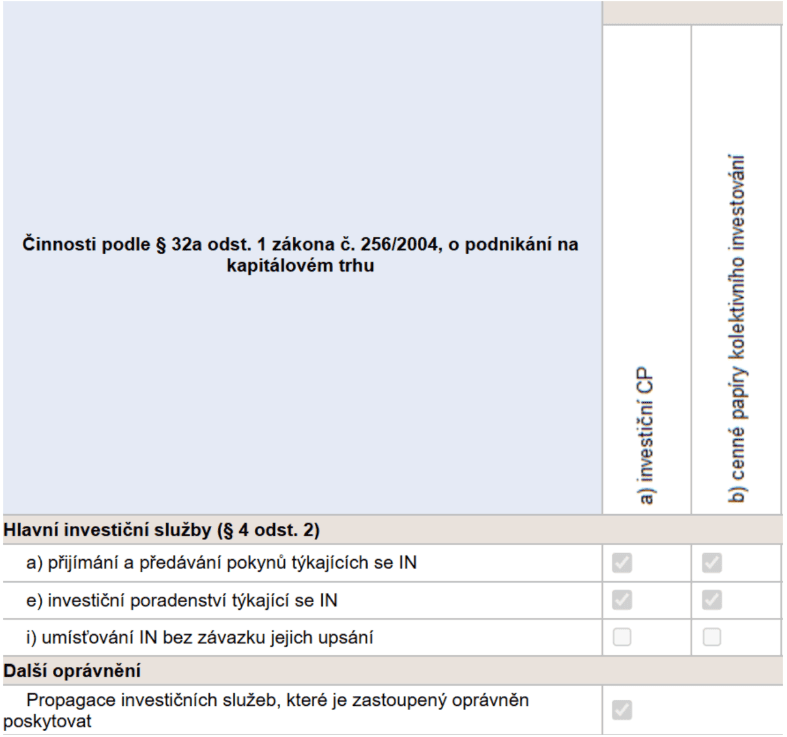
Did you know that the promotion of investment advice is, in itself, a regulated activity. The individual should be on the Czech National Bank register. Here is a snippet from my registration (Propagace investičních služeb, které je zastoupený oprávněn poskytovat- refers to promotion).
And for the expats on the receiving end? If they invest through an unregulated firm and something goes wrong, there is no Czech investor compensation scheme to fall back on. No regulatory body with jurisdiction. No straightforward route to redress. Just the slow realisation that the person who seemed so helpful in the comments was operating entirely outside the system designed to protect them.
Now, it is entirely possible that our non-Czech regulated IFA is not acting in bad faith. The expat financial advice market has always attracted people who are genuinely trying to help fellow countrymen navigate confusing systems abroad. But good intentions do not create regulatory authorisation. And the history of offshore, commission-driven expat investment products — the very history the burned commenter was warning about — is
littered with advisers who meant well and caused harm anyway, precisely because they operated outside proper oversight.
Three questions worth asking anyone offering financial advice
- Are you authorised by the ČNB, or do you hold a regulatory passport from an EU/EEA member state?
- Are you personally registered to provide investment advice to EU-resident clients?
- Can I verify your firm on the ČNB public register at cnb.cz?
If the answers are vague, move on.
The ČNB maintains a public register of authorised firms and individuals.
It is free, online, and takes thirty seconds to check and that is thirty seconds a non-Czech regulated IFA is probably hoping nobody spends at all.
Use this link and click on Search. You will be asked to verify yourself through a simple on screen number to fill in. Then type in your advisor’s information.
The broader irony is rich. The commenter who warned against all financial advisers was, in the most cynical reading, not wrong. But the solution isn’t to distrust everyone — it’s to check.
Summary
Regulated advisers exist. EU-passported firms operate legitimately across the bloc. Good advice is available. It just doesn’t tend to arrive unsolicited in a Facebook comments section from someone based in Prague representing a firm five thousand miles away that in not regulated to advise in this country (or the EU).
