

Why “I’m Fully Qualified” should make every British expat ask one more question
The three most expensive words in financial advice
Spend five minutes browsing LinkedIn and you’ll find dozens of profiles proudly declaring: “Fully qualified British financial adviser helping expats across Europe.” It sounds reassuring. Professional. Authoritative. There’s just one tiny problem: fully qualified for what?
Imagine a pilot announcing, “Good morning ladies and gentlemen. I’m fully qualified.” You’d probably ask, “To fly this aircraft?” Yet in financial services we often accept the phrase without asking which country, which regulator or which legal framework it actually refers to.
The qualification that doesn’t exist
Here’s the awkward truth: there is no universally recognised professional qualification called “Fully Qualified Financial Adviser”. It is a marketing description, not a regulated designation.
- Which country awarded the qualification?
- Which regulator authorises the adviser?
- Is the qualification recognised in the country where I live?
- Can the adviser legally advise on local pensions, investments and insurance?
The safest clients are not the ones who know the most about investing. They’re the ones who know which questions to ask before taking advice.
Brexit changed the map
Before Brexit, many UK firms relied on EU passporting rights. Those arrangements largely ended for UK-authorised advisers. A qualification from the Chartered Insurance Institute (CII) or CISI remains valuable professionally, but it is not automatically recognised as satisfying competence requirements in every EU member state.
That distinction matters because professional qualifications and regulatory permission are related but different. An adviser may possess excellent UK credentials while still needing separate recognition, licensing or local competence to advise in another European jurisdiction.
Where EFPA fits in
The European Financial Planning Association (EFPA) was created to promote consistent professional standards across Europe. Unlike many purely academic qualifications, EFPA certifications include local legal, taxation, pension and regulatory knowledge through each national EFPA organisation.
Importantly, EFPA is not a magic passport either. It recognises common professional knowledge while acknowledging that every country has different laws. Advisers moving between member states typically complete country-specific bridging requirements rather than simply transferring qualifications unchanged.
The Prague restaurant test
Imagine you’re dining in Prague.
- Chef: I’m fully qualified!
- You: Excellent. Qualified in Czech food hygiene?
- Chef: No, British.
- You: Czech allergen regulations?
- Chef: No.
- You: Czech licensing?
- Chef: No.
- Chef: But I’m fully qualified!
You’d probably ask for the licence before ordering the steak. Financial advice deserves the same healthy scepticism.
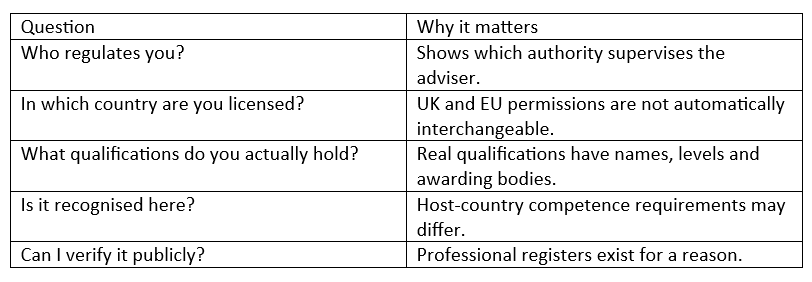
Five questions every expat should ask
Red flags disguised as confidence
Be cautious if a profile says “fully qualified” but never mentions the actual qualification, avoids naming the regulator, claims to advise across numerous EU countries without explaining the legal basis, or relies entirely on impressive initials while ignoring local authorisation.
None of these automatically means someone is doing anything wrong. They simply mean you should ask better questions before becoming a client.
The bottom line
Experience matters. Qualifications matter. Ethics matter. But “fully qualified” is not evidence—it’s advertising. The safest clients are not the ones who know the most about investing. They’re the ones who know which questions to ask before taking advice.
Author’s note
This article is intended for general information and consumer awareness. Qualification recognition and licensing depend on the laws of each EU member state and should always be verified with the relevant national regulator or professional register.
