
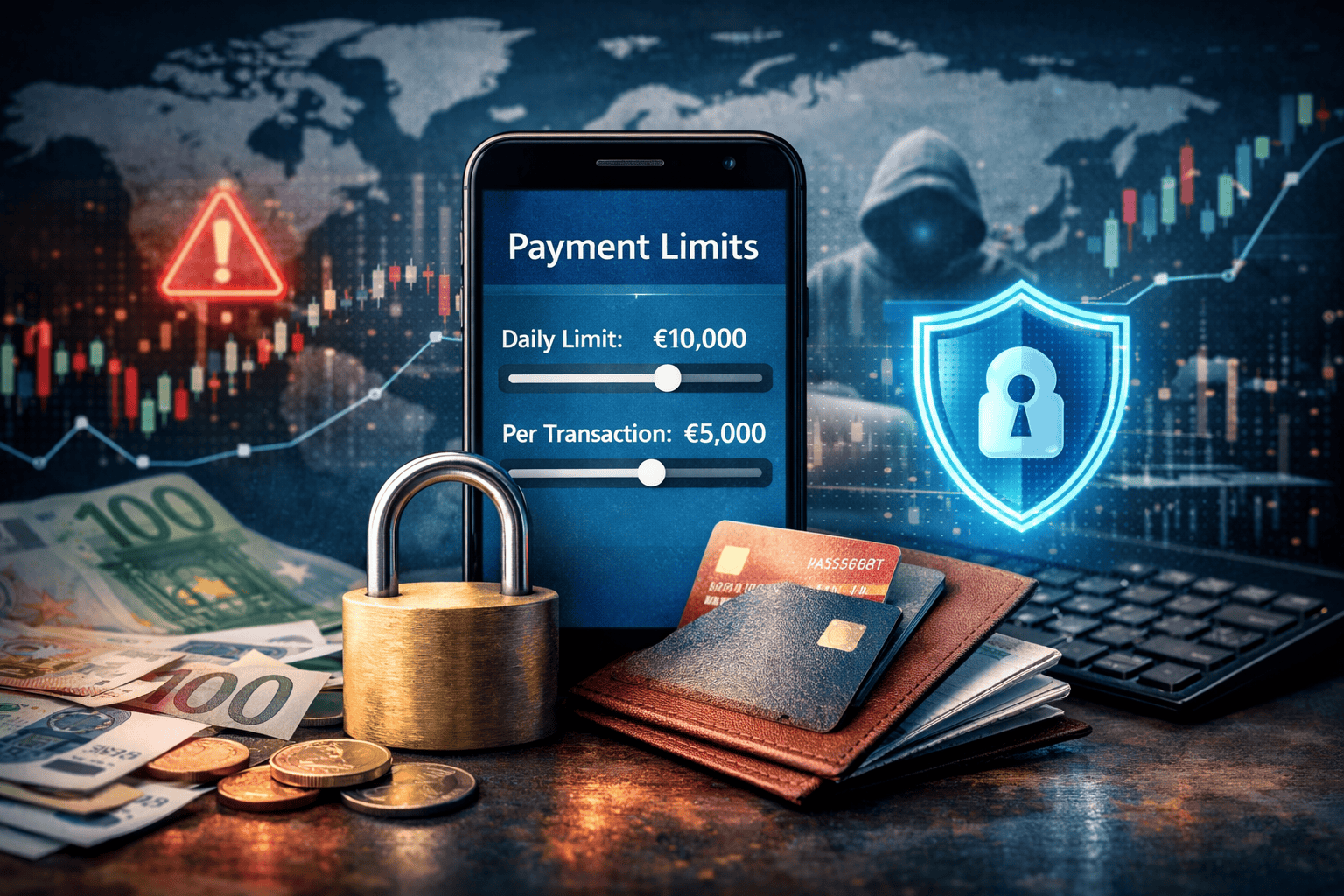
Today, financial risk is often found not in the investment itself, but in the act of moving money. For international clients, expats, and affluent families, a single compromised device or a sophisticated phishing attack can lead to the immediate and irreversible outflow of hundreds of thousands of Euros. While the EU’s payment infrastructure is fast and highly digitalized, client protection often remains hidden in complex settings that the average user—or even an experienced investor—rarely reviews.
Managing your payment limits is no longer just a technical task; it is a critical pillar of asset protection. Properly configured limits are not an inconvenience—they are an insurance policy. European supervisory authorities have recently clarified that clients must have the power to decide how much, from where, and through which channel their funds can be transferred. This is where formal compliance transforms into real-world security.
Who holds the keys to your transactions?
In late 2025, the European Banking Authority (EBA) reinforced interpretations of rules that have significant practical implications. Payment Service Providers (PSPs) are permitted—and often required—to set different limits based on the transaction channel (e.g., different thresholds for mobile apps versus online banking or physical terminals). However, the crucial factor is whether these limits are explicitly agreed upon in the framework agreement and if the client is fully aware of them.
In practice, we often see dangerous extremes. A client with substantial assets may have their mobile app limit set to a default consumer level—or, conversely, have no limit at all. Both scenarios invite disaster. In the event of fraud involving instant Euro payments, typical losses range from €25,000 to €100,000 within minutes, with practically zero chance of recovery once the funds leave the SEPA zone.
Instant Payments: Speed that leaves no room for error
The new Instant Payments Regulation (IPR) has introduced a specific regime for Euro transfers. Upon a client’s request, banks must allow for a specific limit to be set—either per transaction or per day. Crucially, this limit must be adjustable at any time before a payment is initiated and must apply across all channels, including mobile devices.
However, this doesn’t mean you shouldn’t have additional layers of defense. Combining a global “instant payment” cap with much stricter limits for mobile-initiated transfers is the most effective way to thwart fraud that specifically targets mobile devices during international travel.
Ask yourself: If your phone were compromised today, what is the maximum amount that could be moved in the next ten minutes? If you don’t know the answer, the risk is already unmanaged.
Practical asset protection in 2026
Setting payment limits is a core part of wealth management. These limits should reflect your lifestyle, income structure, and international exposure. What works for daily operational expenses rarely makes sense for large-scale investment transfers or cross-border property acquisitions.
At Aisa International, we analyze a client’s actual payment behavior—transaction frequency, currencies used, and risk profile. We then ensure that limits are established contractually and technically, with regular reviews to match changing needs. The result is not a loss of flexibility, but the gain of peace of mind.
EU regulations are often written in a language that discourages active engagement. Yet, within that complexity lies the opportunity for superior protection. A passive approach means the bank sets the rules for you. An active approach ensures the control remains in your hands.
